So
You’ve Got Mold In Your Attic? Now What?
Simple
Strategies For Understanding and Correcting Attic Mold
Attic
mold is extremely common
in our Northern climate. Attic mold is generally directly
attributable to 3 basic causes:
Lack
of adequate ventilation or improper ventilation.
Existing
or past roof or flashing leaks.
Ice
damming as a result of inadequate insulation and failure to
incorporate “Ice Guard” along the eves.
Improperly
exhausted bathroom fans and or dryer vents.
We
will briefly discuss each problem and the appropriate remedy as well
as covering the basic abatement strategies offered in our area and
why our system
is SUPERIOR
to all of our “so-called competitors”.
By
far the most common cause of all attic mold is improper
ventilation.
Let’s
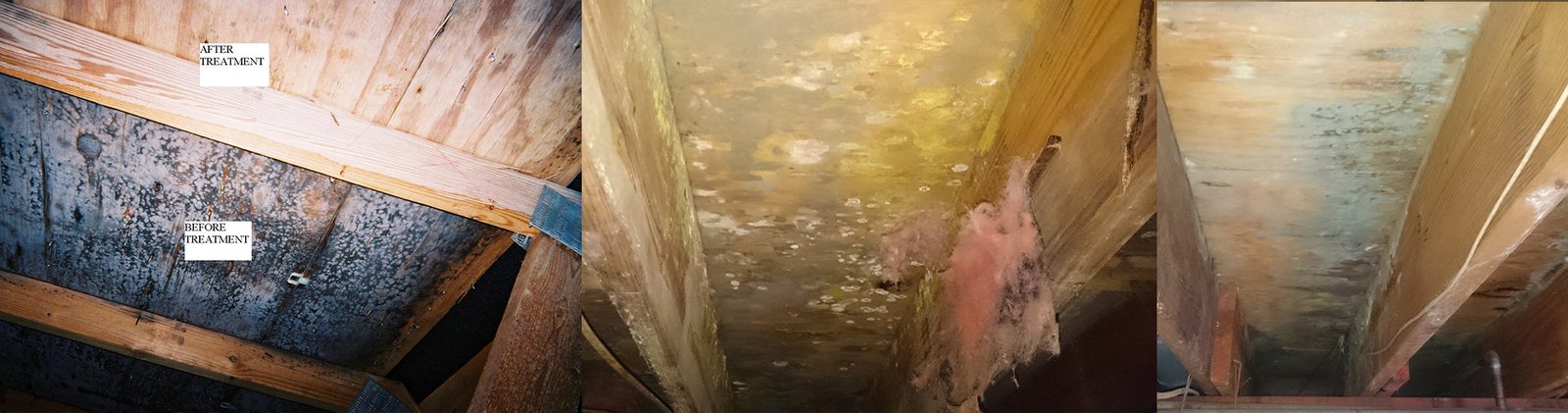
start by explaining that in most attics the mold does NOT
grow in the summertime.
This is because during the spring summer and early fall months the
daytime temperature of the attic is far
to warm for the mold to
effectively grow and the humidity levels inside the attic are
typically too low to allow for mold growth. Most mold will only grow
between 40 and 90 degrees Fahrenheit. Some molds that belong to a
special class of mold ( the ones usually affecting northern climate
attics) called the Chrysophile molds will grow in temperatures as low
as the 20’s.
HOW
THE MOLD GROWS
During
the winter months when we heat our homes, some of the heat is
inevitably lost into
the un-heated attic space. This hot air mass then moves upward where
it will dissipate outside if
the attic is properly vented.
If
however the attic is poorly
vented the hot trapped air
will encounter the cold surface of the underside of the roofing
boards or sheathing. This hot –air- meets- cold-surface
results in dew-point being achieved. This dew-point created
condensation and is often more noticeable on the nails as the nails
are more efficient at conducting the cold temperature from outside.
The condensation then forms water droplets which can drip onto the
floor of the attic or worse
sometimes run down into the wall cavities below resulting in
potentially “hidden “ mold which can be the source of
frustrating to diagnose health
problems.
Often
a roof will have sufficient roof ventilation but the soffits (eves)
are not vented. Even more common when a house receives new siding
the siding contractor will install vented soffit panels giving the
eves the appearance of being vented when in reality they are not, as
no holes were ever cut into the plywood covering the bottom of the
eves. Sometimes the attic is ventilated properly but an overzealous
attempt to insulate has blocked the air flow from the soffits to the
ridge preventing proper ventilation. An easy way to check whether or
not the vents are there or are functioning properly is to go up into
the attic on a sunny day, extinguish all lights and look
for daylight coming in
along the edges. A well ventilated attic should allow visible
daylight in along the edges.
What
is the best way to vent the roof?

Roof
ventilation is divided into two categories:
Incoming air and Outgoing
air.
Incoming
Air: The most effective way for
air to enter the roof is through vents that are placed in the soffits
along the eves. Continuous strip vents provide the most reliable
ports as well as rectangular vents. Round ventilator plugs are easy
to install but are usually to small to provide adequate air flow.
Outgoing
air: Stale or heated air
escapes through the top of the roof. There are many ways to achieve
sufficient ventilation including : Ridge Vents , Turbines or Powered
Vents, Box Vents and Gable End Vents.
Continuous
ridge vents are the preferred method for eliminating built up hot air
but may not be sufficient to ventilate short ridged roofs like hip
roofs.

Ventilating
heated attics or cathedral ceilings properly is often neglected
during initial construction. This often results in ceiling drywall
growing mold on the back side when the builder fails to vent and
baffle the area behind the ceiling insulation and drywall.
Roof
leaks always need to be
addressed by a professional roofer and special attention needs to be
paid to flashings around chimneys and indeed any penetration found in
the roof decking. Flashings often require maintenance between roof
shingling jobs and are extremely important to maintain. Roof leak can
often develop into festering mold problems both in the attic cavity
or WORSE inside of hidden wall cavities in the home.
Ice
Damming occurs along the
eves immediately above the plate-line of the exterior walls. Leakage
in this area easily penetrates into wall cavities where it can become
trapped between exterior finish materials and interior vapor
barriers. A surprisingly small amount of water can raise the
relative humidity of a wall cavity to damaging levels. Mold growth
may eventually become visible along the wall base as it penetrates
from exterior to interior wall surfaces. More critically spore and
VOCs (Volitile Organic Compounds) released by mold can aggravate
serious health problems in the houses occupants. Especially at risk
are the very young and the old as well as Allergy –sensitive or
immuno-compromised adults.
In
some mild cases ventilation corrections are enough to cure the
problem in severe cases the roof shingles must be removed and strips
of “Ice – Guard” be installed along the eves to
prevent damming. In severe cases the exterior wall drywall must be
removed and the wall cavities treated as well.
Improperly
vented bathroom fans: Bathroom
fans and dryer vents can generate a lot of moisture. They should
always be vented directly up and out through the roof. Often times
builders or do it yourselfers will discharge fans or dryer discharges
directly into the attic, greatly increasing the overall humidity.
Do-it-yourselfers often try to connect more than one fan into a
discharge and will commonly run the discharge out to the eves or
soffits rather than straight up and out through the roof. The remedy
is simple one fan one roof vent directly vertically up through the
roof overhead. On the outside the vent has a hat and is not a risk
for water leaks,
HOW
DO I TREAT THE MOLD?
Unfortunately
there are as many “treatments” for mold as there are
remediators out in the real world offering “mold remediation”.
Attic mold problems are especially challenging for a homeowner to
solve as the mold industry has no National Guides so the list of
options is confusing and often indecipherable with the average “mold
guy” promising the latest craze. Mold spores can grow at
alarming rates. One mold spore can develop into 12 million in twelve
hours!
Also
the mold is feeding on the boards, and what you can see with the
naked eye are millions and millions of them clumped together. What
you can’t see are the “roots” The organism itself.
The roots of mold grow into the substrate at least 3/16 of an inch.
What we think of as the mold the clumped spores are actually the
fruit or reproductive body like an apple to an apple tree. You
cannot hope to solve a mold problem leaving these roots and treating
only the surface of the wood. Also the majority of the chemicals
being used on the market today contain known cancer causing chemicals
and worse do not work on porous surfaces (every surface in an attic).
The
mold certifying authorities
recommend putting the attic under negative pressure. This means
using expensive equipment to suck more air into the attic than
escapes from it. The next recommendation is to remove the insulation
into plastic bagged which are taped shut. Then to HEPA vacuum the
attic boards trusses and ceiling. Next manually wash all of the same
areas with a detergent solution. Finally to correct the ventilation
issues.
The
Problem: This is an
extremely man hour intensive process that costs a ton of money. it
also does nothing to address the spores (mold seeds) or to address
the roots ( the organism itself). Additionally when you correct the
ventilation you bring new spore into the attic every single day.
The
other contractors in the area use a variety of techniques that can be
broken into three main groups: the fog and Encapsulators (spray and
spray painters) the bleach and ozonators and the franchise users.
First
group the fog and encapsulators:
by far the most common these contractors will tell you that all that
is necessary is to go into the attic and fog a “magic”
chemical and then to encapsulate the mold using a poisoned mold
inhibiting paint. Many of these charlatans will not even admit that
their encapsulant is a paint. Usually the paint has a heavy metal
added to it like copper or tin or zinc. Sometimes they have a toxic
chemical added to them to discourage mold growth.
The
problem: These contractors
almost exclusively use fungicides that are not sporicidal. This means
that they do not kill spores and most of them will not penetrate a
porous substrate (like wood). This means that when they apply the
encapsulant they are applying it directly over the moldy roots. This
is a huge no –no as the vapor barrier forming nature of latex
paints can cause dew-point to be achieved between the paint and the
wood itself. Have you ever seen what happens when you lay a piece of
plastic sheeting or drop-cloth on the ground overnight in the
summertime? Did you ever notice those beads of water or dew? That’s
because the Earths temperature in the summertime is cooler than the
outdoor air. Precisely what happens when you treat an mold attic with
any kind of paint. The paint begins to delaminate and I have seen
mold growing directly on Mold-proof paint! We have had to re-treat
over 40 of these attic mold jobs in the last year alone!

The
bleach and ozonators: these
contractors will go into the attic and spray bleach onto the wood.
The reason is to remove the stains, many of these companies will not
admit they are using bleach! Just ask them what the active ingredient
is in their “stain remover” if it is sodium hypochlorite
“ its bleach.
These
contractors usually refuse to warranty their work and they will claim
that the Ozone cannons they use will turn the spores into ash.
The
problem: Bleach has an ion
structure that prevents it from penetrating into a porous substrate
like wood, this means it leaves the roots un-harmed. It also
releases a powerful environmental toxin called Dioxin. While the
ozone cannons will destroy the chemicals off gassed by the bleach
this technique leave the complete root structure intact and
guarantees that if you ever have a new water leak the mold will go
right into full production and the mold problem will immediately
return.
The
Franchisors: These
contractors have bought into a “system” most often using
toxic chemicals which can harm you and your family.
The
problem: Often their
warranties aren’t worth the paper they are printed on as they
only agree to replace the chemicals if they fail. Usually the fine
print in the warranty makes it worthless. Often these are money
seekers who use low dollar labor as the owners bought into the
franchise so they didn’t have to work on the job (just like
subway shops)
I
discovered to my surprise about 6 years ago that the chemicals that
were being used by my so-called competitors (and indeed by most of
the industry) not only DIDN’T
WORK on porous surfaces…
which is about EVERY
surface that mold would grow on in a house. I also figured out that
most of these chemicals contain
NO ingredients that KILL
the spores (the most
important but hardest
things to kill) and also …that they leave behind RESIDUAL
TOXIC CHEMICAL POISONS that
in some case are WORSE
than the poisons the MOLD makes!
Yikes!
I found this out the hard way, cause in the beginning, believe it or
not, I used the same old
chemicals that everyone
else in the industry STILL
USES!
And
you know how I found out? I had three “special Ladies”
that got sick
from the chemicals I used
in their homes. I call these ladies “special” because
due to living with extremely TOXIC mold, they developed a RARE
condition called Multiple Chemical Sensitivity Disorder. Ever heard
of it ? I hadn’t. I can honestly say that I thought they were
trying to get money back for a job WELL DONE. But…
Since
I had three of them in a row, I decided to try and see if there might
be anything
to their claim of sickness. I discovered that their noses worked
actually much BETTER than a “regular” persons nose
(someone without multiple Chemical Sensitivity Disorder).
HMMM!
I began to theorize that maybe I was POISONING ALL OF MY CUSTOMERS,
but our “regular noses” just couldn’t smell it.
I
quickly began to research. Just what was in those chemicals? After
all, they were EPA approved and biodegradable. What I discovered
truly SHOCKED THEN HORRIFIED
ME…
The
EPA routinely approves products that contain known carcinogens (those
are CANCER CAUSING
chemicals) … I was
AGHAST!
I
quickly realized that I need to do some research and change the
chemicals that I used –FAST! So I got together with some of
the countries top scientists. I met many very, very smart people who
had already devoted their ENTIRE LIVES to the cause. I read TONS
of material about mold and the different ways to KILL
MOLD. I took ALL
of the good ideas
that I learned from all these sources and EXPERTS and...
Then
I FUSED
them all together into a system
that is absolutely LETHAL
to mold but remains SAFE
for your entire family! In fact it leaves behind NO
known residual poisons that can make people sick. It cost me a
FORTUNE
to do.

Our
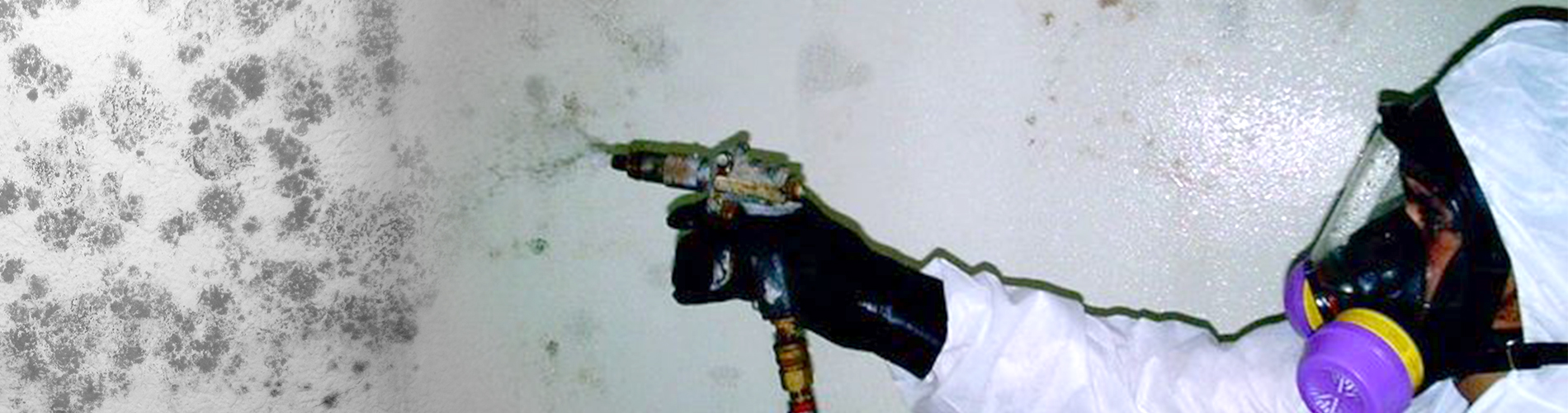
System: The first thing we do
is isolate the attic from the rest of the house. Next we SATURATE all
of the moldy trusses and sheathing with a disinfectant the uses the
amazing power of Hydrogen Peroxide natures miracle disinfectant. The
reason we start with this is when mold is senses it is being attacked
it releases its spore into the air, a phenomenon called bursting or
sporulation. Hydrogen Peroxide is unique among the mold killing
chemicals as it is the only liquid I know that will completely
destroy a spore (mold seed).
This
way we kill the spores before they can spread all over. Next we
apply the stain removing solution. This is absolutely a must, because
while truly only cosmetic in nature, failure to apply the stain
remover will result in untrained eyes (home inspectors ) believing
that the mold is still active. Next and most important to the
warranty and long term efficacy of the process we actually impregnate
the wood with an environmentally friendly solution of borate called
ENVIROTECH WP. This is made from extremely finely ground and
specially designed for dissolving borax a cousin to the old fashioned
20 mule team we use in our laundry. This product is absolutely
amazing. It was designed to penetrate the substrate a full inch
(remember mold roots only grow 3/16’s of an inch into the
wood). It not only prevents all hosts of decay and dry rot fungi but
it also prevents wood boring insects carpenter ants and termites.
Imagine you get a complete two for one bonus mold proofing and bug
proofing in one fell swoop! Then we even dry fog the powdered
ENVIROTECH WP all over the insulation.
Lastly I discovered the
scientists at Los Alamos national laboratory have extensively studied
how to decontaminate a civil facility like a house that has been
contaminated by a spore based pathogen like toxic mold. The
scientists concluded that if you only follow the guidelines
recommended for mold that you will leave the structure contaminated
with spore. They conclude that in order to fully decontaminate the
structure/ area it is absolutely necessary to fill it full of toxic
levels of a reactive gas like ozone. While other mold guys are still
using poisonous ozone gas we use a specialty gas called ARAN. Which
is a gas made of isotopes of pure oxygen that go all the way up to